

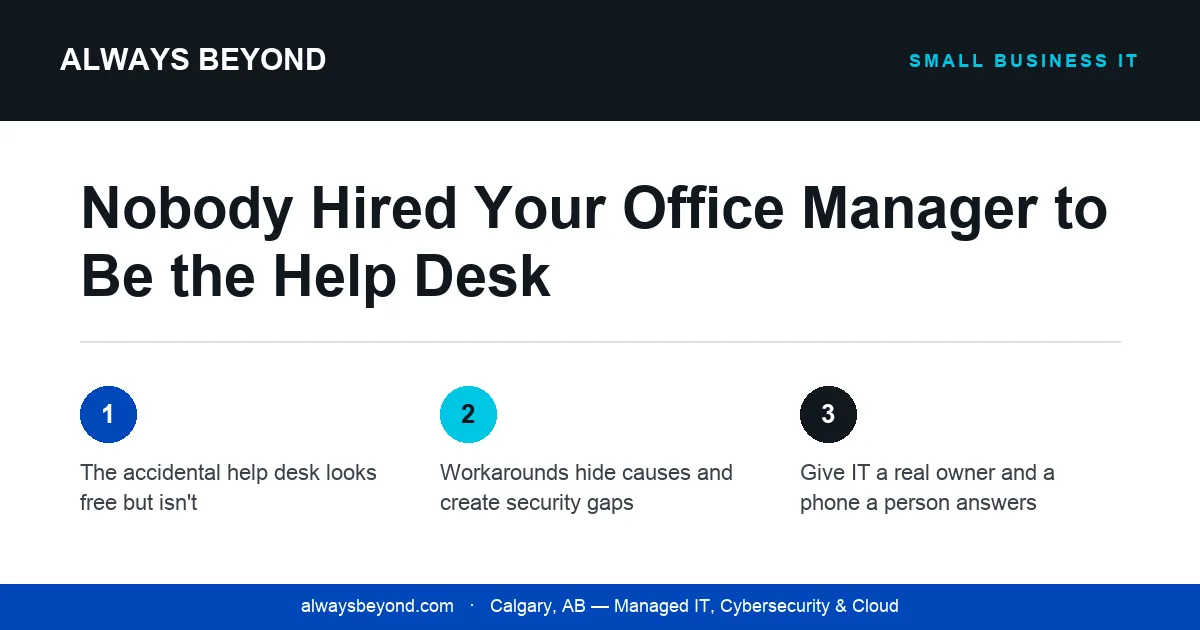
Every growing business has one. She was hired to run the office: vendors, payroll paperwork, the supply order, the front desk. Then one day the printer jammed and she fixed it. A month later she reset someone’s password because she happened to know where the admin login was kept. Now, two years on, she is the first call for every frozen laptop, every Wi-Fi complaint and every “is this email a scam?” in the building. Nobody ever decided this. It simply happened.
I have a lot of sympathy for this person, and for the owners who rely on her, because the arrangement looks free. It is not. It is one of the more expensive habits a small company can fall into, and the cost hides precisely because it never shows up on an invoice. If you are deciding whether to pay for managed IT services in Calgary or keep “managing fine” on your own, price out what managing fine is really costing before you compare it to a monthly fee.
The accidental IT department
The accidental help desk usually forms around whoever is organized, approachable and not afraid of a settings menu. Those are wonderful qualities. They are also exactly the qualities you hired that person for in the first place, and every hour she spends troubleshooting is an hour she is not doing the job on her actual job description.
The interruptions are the real problem. IT trouble does not book a meeting. It arrives as a tap on the shoulder in the middle of month-end, a panicked message during a client visit, a laptop placed on her desk with a hopeful look. Each one breaks her focus, and the work she was doing before the interruption takes longer to finish after it. Multiply that across a week and you have quietly converted a capable operations person into a part-time technician with no training, no tools and no backup.
What it quietly costs
Start with the obvious cost: her time. Then add the less obvious ones.
There is the cost of fixes that are not really fixes. Without proper tools or visibility, the accidental help desk solves problems the only way available, by restarting things and finding workarounds. The symptom goes away; the cause stays. The same issue returns next month, and nobody connects the dots.
There is the security cost. When the person handling access is also juggling ten other responsibilities, shortcuts creep in. A shared admin password. An ex-employee’s account that nobody got around to disabling. Backups that were set up once and never checked. None of this is her fault. It is what happens when security work is done in the gaps between other work.
There is the risk of a single point of failure. If she goes on holiday, gets sick or takes another job, the knowledge of how everything is set up leaves with her. Picture discovering, the week after she leaves, that nobody else knows the login to the domain registrar or where the backups actually go.
And there is the morale cost. Many people in this position quietly resent it. They did not sign up to be on call for technology, and they are rarely thanked when things work.
Giving the job back
The fix is not to forbid her from helping. It is to give IT a proper home so she is no longer the default.
That starts with an honest inventory. Ask her to keep a simple log for two weeks: what people asked her to fix, how long it took and what she was doing when they asked. That log will tell you more about your IT needs than any sales conversation.
Next, decide who owns the hard parts: user accounts, security settings, backups, device setup and the vendor relationships with your software providers. Whether you build that capability in-house or bring in an outside provider, it should be someone’s actual responsibility, with tools to match and documentation that does not live in one person’s head.
Then let your staff call that someone directly. A help line staffed by a real person removes the shoulder tap entirely, and it tends to surface problems earlier, because people are far more willing to report a glitch when they are not interrupting a colleague to do it.
Your office manager will still be the one who knows where everything is. She just will not be the one fixing it at four o’clock on a Friday. Ask her how her week would look without that, and listen closely to the answer.