

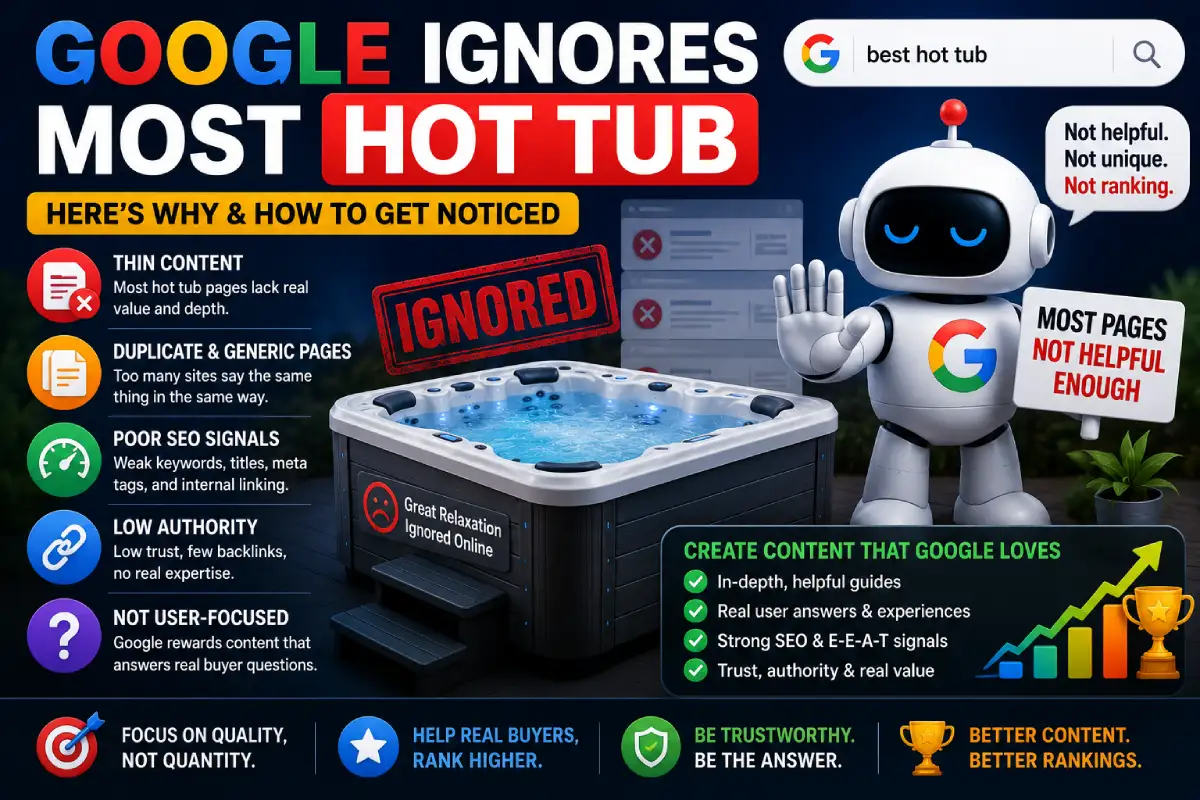
If you own or manage a hot tub dealership, there’s a decent chance your website has a blog. There’s an even better chance that blog hasn’t been touched since a summer intern wrote “Top 5 Benefits of Hydrotherapy” back in 2023. You’re not alone — and unfortunately, that’s exactly the problem.
Search engines have gotten remarkably good at separating businesses that publish with purpose from businesses that publish out of obligation. And now, with AI answer engines like ChatGPT, Perplexity, and Google’s AI Overviews summarizing the web for shoppers, the gap between dealers who show up and dealers who don’t is widening fast.
Let’s break down why most dealer blogs get ignored — and what it takes to become the exception in your market.
The Real Reason Your Blog Is Invisible
Here’s the uncomfortable truth: why blogging once a year is hurting your hot tub dealership comes down to how modern search algorithms evaluate trust. Google’s systems reward sites that demonstrate ongoing expertise, freshness, and depth on a topic. A single annual post signals the opposite — it tells the algorithm your site is dormant, your information may be stale, and your dealership isn’t a living authority on spas.
Think about it from Google’s perspective. A shopper searches “how much does a hot tub cost to run per month.” Google can send them to a manufacturer site updated weekly, a national retailer with 200 detailed guides, or a local dealer whose last post is a holiday sale announcement from two winters ago. The algorithm makes that choice in milliseconds, and it rarely favors the dormant site.
The same logic now applies to AI search. Large language models and answer engines pull from sources they assess as current, comprehensive, and well-structured. Thin, outdated content doesn’t make the cut when Perplexity assembles its cited answer, or ChatGPT recommends where to buy a spa in your city.
What Google (and AI Engines) Actually Reward
The dealers winning organic traffic in 2026 share a few habits worth stealing:
- They answer real buyer questions — completely. Instead of vague lifestyle fluff, top-performing dealer content tackles the questions shoppers actually type: saltwater versus chlorine systems, 110V versus 220V installation, winter energy costs, financing options, delivery logistics for tight backyards. Each post fully resolves one question. That completeness is what earns featured snippets and AI citations.
- They publish consistently, not constantly. You don’t need daily content. Two to four substantive posts per month is enough to signal an active, authoritative site. Consistency compounds: every quality article becomes another entry point for local searchers and another page an AI engine can reference.
- They write for humans first, structure for machines second. Clear headings, direct answers in the opening paragraphs, FAQ sections, and plain language all help both readers and crawlers. AI engines in particular favor content that states conclusions plainly rather than burying them under marketing copy.
- They localize. “Best hot tub for cold climates” is competitive nationally. “Best hot tub for Minnesota winters — advice from a Twin Cities dealer” is a lane you can own. Local specificity is the single biggest advantage independent dealers hold over big-box retailers and manufacturer sites.
- They demonstrate first-hand expertise. Google’s quality guidelines explicitly prioritize experience. Photos from real installations, service technician insights, water care troubleshooting from your own showroom — this is content no national competitor can replicate, and it’s precisely what E-E-A-T signals are built to detect.
How to Become the Exception
Ready to turn your blog from dead weight into a lead engine? Start here:
Audit what you have. Update or consolidate old posts. A refreshed, expanded article often
outranks a brand-new one because it carries existing history.
Build a question-first content calendar. Ask your sales team for the ten questions they answer most on the showroom floor. Those are your next ten posts.
Add structured data. FAQ schema, product schema, and local business markup make your content easier for search engines and answer engines to parse and cite.
Include a direct answer up top. Open each post with a two-to-three sentence summary that resolves the query. That’s the passage AI tools are most likely to quote — with your dealership’s name attached.
Link content to conversion. Every article should offer a natural next step: a pricing guide download, a wet test booking, or a backyard consultation request.
Search visibility is no longer a bonus for hot tub dealers — it’s the front door of your showroom. An abandoned blog quietly tells Google, ChatGPT, and every shopper who finds it that your dealership isn’t the local authority. A consistent, question-driven publishing strategy tells them the opposite.
The dealers who commit to that strategy now will own their local search results — and the AI-generated answers — for years. The ones who keep posting annually will keep wondering where their web leads went.